
The Story
When Sarah and Mike bought the craftsman bungalow on Maple Street, the realtor mentioned the crawlspace only once.
"Storage," she said, waving a dismissive hand. "Old houses have quirks."
The quirks started on their third night.
Sarah woke at 3 AM to scratching beneath the bedroom floor—rhythmic, deliberate, like someone dragging fingernails across wood.
She nudged Mike awake. He heard nothing.
By morning, she convinced herself it was pipes, or the house settling, or squirrels that had found their way under the foundation.
The second sound came three nights later. A whisper, so faint she almost missed it. "Sarah."
She sat bolt upright in bed, heart hammering against her ribs. "Mike?"
Her husband slept on, snoring softly. The voice had been too high, too thin—like a child speaking through a mouthful of cotton.
"Down here, Sarah. We're down here."
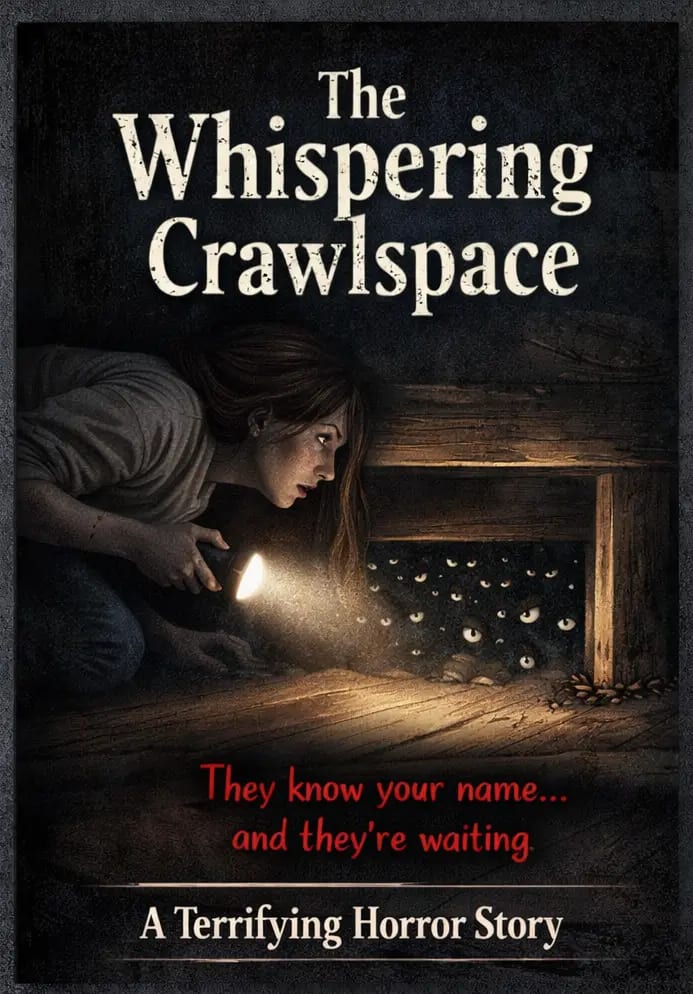
Sarah grabbed her phone and shone its light at the floor. The vent grate in the corner of the room seemed to stare back at her, a dark rectangle beckoning her to look closer.
She told herself she wouldn't. She promised herself she'd call an exterminator in the morning.
She approached the vent on trembling legs.
"Hello?" Her voice cracked. "Is someone there?"
Silence stretched for thirty seconds. Then, from somewhere deep beneath the house, came a giggle—high and sweet and absolutely wrong.
"We heard you moving around upstairs," said the voice. "We haven't heard footsteps in so long. Will you come play with us?"
Sarah stumbled backward, her heel catching on the rug. She fell hard, landing on her palms. The phone skittered across the floor, its light spinning wildly. For a fraction of a second, it illuminated the vent.
There were eyes looking back.
Dozens of them—small, round, pale as moonstone—clustered in the darkness beyond the grate. They blinked in unison.
"She sees us," whispered one voice.
"She's pretty," whispered another.
"Pretty enough to keep," chorused a dozen voices together.
Sarah scrambled to her feet and ran.
She grabbed Mike by the shoulders and shook him awake, babbling about eyes and whispers and the crawlspace.
He went to check with a flashlight and a baseball bat, muttering about raccoons or opossums or his wife's overactive imagination.
He found nothing. The crawlspace was empty—dirt floor, cobwebs, the smell of mildew and old earth. No eyes. No whispers.
But on one wooden support beam, carved deep into the wood with something sharp, were names. Dozens of names. Emma. 1912.
Thomas. 1912. Mary. 1912. David. 1912. All the names ended with the same year.
And beneath them, fresher, the carving tool having bit deeper into the aged wood: Sarah. 2024.
Mike didn't see the carving. Sarah didn't point it out. She grabbed his arm and pulled him back through the access door, sealing it behind them. That night, they stayed in a hotel.
Sarah called a contractor the next morning to pour concrete over every entrance to the crawlspace. "Radon concerns," she told them. She never mentioned the eyes or the whispers or the names carved in wood.
The house sold two months later—to a young couple with a newborn baby who thought the craftsman details were charming. Sarah drove by once, months after they'd moved, and saw the new owners installing a swing set in the backyard.
She didn't stop. She didn't warn them. Some things, once sealed, should stay sealed.
That night, she woke at 3 AM to scratching beneath her new apartment floor—different building, different city, impossible distance.
And beneath the sound of nails on wood, she heard whispers. Dozens of them. Calling her name.
They had found her. They always find you, once they know your name.
"Come home, Sarah," they whispered. "Come home and play with us."
End.


💬 Comments (0)
Want to share your thoughts?
No comments yet
Be the first to start the discussion!