
The Story
David found the camera in his grandfather's attic, buried in a crate labeled "HOLLOWAY ESTATE—DO NOT OPEN."
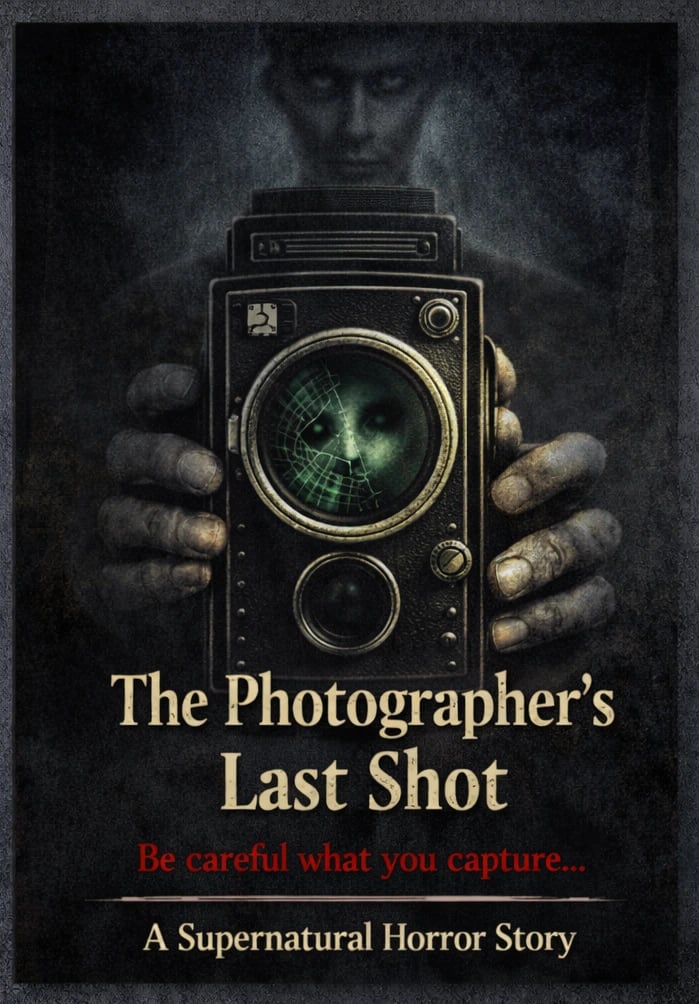
It was a Rolleiflex, vintage 1950s, its leather case cracked but the lens pristine—greener than glass should be, almost organic, like a cat's eye gleaming in darkness.
David was a photography student, always hunting for vintage gear. He cleaned the Rolleiflex, loaded it with medium-format film he'd ordered online, and took it to the woods behind his apartment complex.
The light was golden that afternoon, streaming through oak branches in cathedral beams. He shot a full roll: squirrels, ferns, the sunset filtering through autumn leaves.
He developed the film in his bathroom darkroom that night.
The negatives were wrong.
Every image showed something standing just behind David's subjects. In the squirrel photo, a figure crouched where the tree met the ground—pale, elongated, limbs jointed wrong.
In the fern shot, it stood between the fronds, its face turned toward the camera, features blurred by motion or by choice.
The sunset image was worst: the figure stood behind David himself, one impossibly long hand resting on his shoulder, its face pressed to the back of his head as if whispering secrets through bone.
David checked the camera. The viewfinder showed nothing unusual. He shot another roll, this time of his living room, his kitchen, his bathroom mirror.
He developed immediately, hands shaking now, chemistry splashing across the counter.
The figure was in every frame. Closer each time. In the living room photo, it sat on David's couch, positioned where he would sit, its face a blur of features that seemed to shift when he looked away.
In the kitchen shot, it stood at the stove, watching the empty pot he'd photographed. In the bathroom mirror image—the most terrible of all—it stood behind him with its face revealed, and David saw that it wore his face. His expression. His posture.
A David made of wrongness, of shadow, of the spaces between moments.
The note in the camera case, which David had tossed aside without reading, suddenly seemed vital. He retrieved it from the trash, hands shaking so badly he could barely unfold the yellowed paper.
"To whoever finds this: The Holloway Camera captures souls. It takes a piece of everyone it photographs, and it gives something back.
My brother Thomas used it for thirty years before we realized what he was sharing his life with. The thing in the photos is Thomas now, or what's left of him. The camera has to keep photographing.
It has to keep feeding. If you've taken a picture with it, it's already seen you. The only way to stop it is to break the lens—but do it quickly. It gets faster every time you look."
David looked up. The camera sat on his counter, lens cap off, pointed at him. The green glass seemed to pulse in the fluorescent light.
In the viewfinder, which should have been dark, he saw movement. The figure was climbing out.
It happened slowly, like a photograph developing in reverse—first the blur of motion, then the suggestion of limbs, then the details coalescing into something that wore David's face but twisted it into an expression of endless, patient hunger.
It reached one hand through the glass, then an arm, then shoulders, and David realized he couldn't move, was frozen by the lens's green gaze, was becoming part of the image himself.
He grabbed a hammer from the drawer beside him. It was awkward, heavy, his fingers numb with terror. The thing was halfway out now, smiling with his mouth but showing too many teeth, reaching for him with fingers that tapered to points.
David swung.
Glass shattered. The green eye of the lens died, going dark in an instant, and the thing in the viewfinder screamed—a sound like film tearing, like shutters closing, like memories being erased.
It collapsed into itself, into the broken camera, into the film that was already exposed and ruined.
David burned everything in his backyard fire pit: camera, film, prints, the note. He watched the green glass bubble and melt until it was harmless slag.
But sometimes, when he raises his phone to take a picture, he sees it for just a fraction of a second in the screen's reflection—a figure standing behind him, wearing his face, waiting for the next camera that will let it through.
Because the Holloway Camera wasn't the only one. There are others. There are always others. And they are always looking for someone who wants to capture the perfect shot.
End


💬 Comments (0)
Want to share your thoughts?
No comments yet
Be the first to start the discussion!